
Do the Communion Elements Become the Body and Blood of Christ? Part One
Weirdly, they may. Maybe the Catholics were onto something.

My readers know that I am without credentials. Why would anyone have confidence in my words? I do not have a theology degree and have never held a position in any church. And yet, I delve into deep theological issues, although not without trepidation. The reader may well ask who I am to do so. I too often ask myself the same question. I’m comforted by the words of Emily Dickinson.
I’m Nobody! Who are you?
Are you – Nobody – too?
Then there’s a pair of us!
Don't tell! they'd advertise – you know!

How dreary – to be – Somebody!
How public – like a Frog –
To tell one’s name – the livelong June –
To an admiring Bog!
I suppose being a Nobody frees me to explore Christian concepts and ideas without fear of censure, and that’s a good thing. Protestants do not believe in transubstantiation, so many may be alarmed by my subject. I consider myself a Christian, not part of any denominational group. I attend a Church of Christ church and have been a member for over forty years. And, no, we do not agree with transubstantiation, either.
Gathering In
I’ve been told my mind is like a ferret. I see my mind more like popcorn, with kernels of odd subjects popping open. When something catches my attention, much like the burning bush caught Moses’ attention, I stop to ponder. Sometimes, I remove my shoes to stand on mysterious, holy ground. And the holy ground today is communion. Communion is not simply something we do because we are commanded. I’ve said before that the words of Christ that “man was not made for the Sabbath, but the Sabbath for man” have much more significance than we, or at least I, have previously thought. God gives all good and perfect gifts to man, including communion. We do not do it to please God, even though that should be a consideration, but for our own deep needs. Somehow it helps us, transforms us, and sustains us.
As a refresher, let’s define transubstantiation. It is “the miraculous change by which, according to Roman Catholic and Eastern Orthodox dogma, the eucharistic elements at their consecration become the body and blood of Christ while keeping only the appearances of bread and wine.”1 Transubstantiation was defined in 1551 at the Council of Trent. Perhaps the Catholics were not entirely wrong about this. Let’s see why.
Reaching Out
In the Didache,2 this prayer for the communion bread is found, “We give you thanks, Father, for the life and the knowledge which you have revealed to us through Jesus your servant. To you be glory for ever.”
This Didache prayer for the Bread shows the Logos as revelation. The Logos gives us life and knowledge when we partake in communion. Creation (the life and the knowledge) is not God but reveals God in the light of the Logos. In creation, the Father wills, the Holy Spirit instills, and the Son reveals. Creation can only be known and understood through its Creator.
Hang with me as we think through this. The creation of life and knowledge is not a one-time event. It is an ongoing, dynamic process that God has never ceased. We humans often perceive creation as a process initiated by God but then continuing on its own. As Peter said, some mistakenly believe that "(a)ll things continue as they were from creation " (2 Peter 3:4). Instead of this same old continuation, each moment is different than that which came before. If we stop and think, we will marvel at all that has been revealed in the last hundred years, or even in the last five years, for that matter.
Here’s the thing:
The whole creation is not done being created but is groaning as in the pains of childbirth (Romans 8:22-24). The final revelation is yet to be.
Consider this analogy. Imagine you come across a pack of unlabeled seeds and are unsure of their potential. You plant and nurture them, eager to see what they will become. The 'will' of the plant is contained within the seed, representing its potential. Once the seed is sown, it begins to transform. The type of plant it will become is still a mystery.
The growth of the plant starts beneath the ground. When the seedling emerges, the sun reveals its proper form. Some plants may look similar at this stage.
Here’s the Kicker
Until the unknown plant blossoms and bears fruit, its true nature, its actuality remains a mystery.
Here’s an illustration:
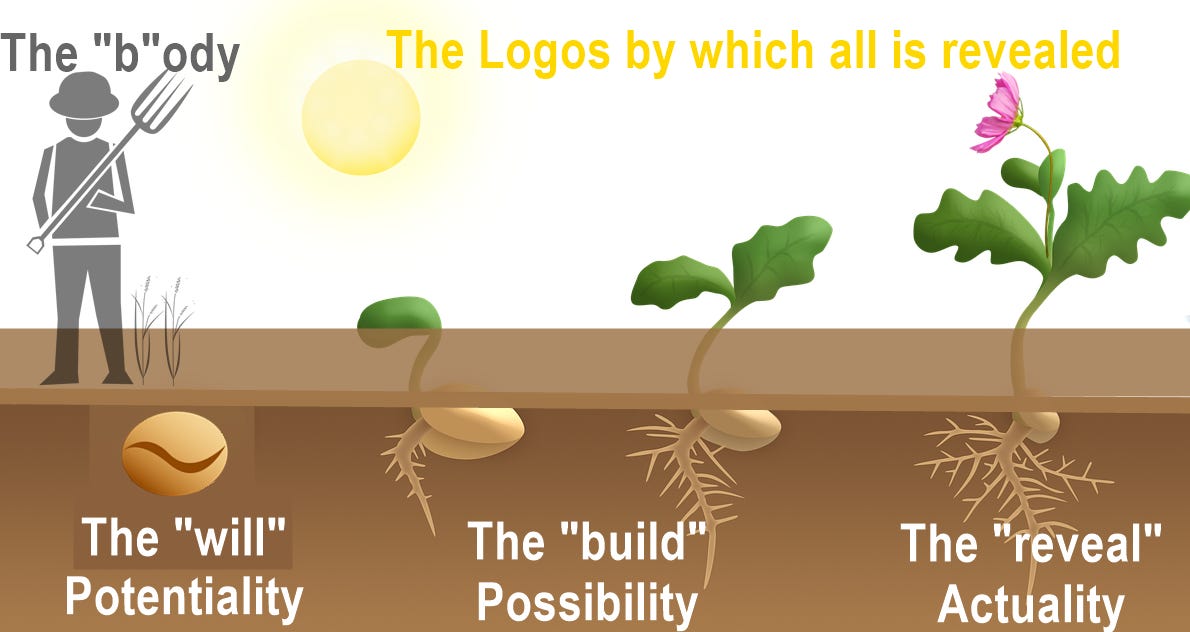
The Father provides us with all good things brought into being by the power of the Holy Spirit, that becomes “seen” and meaningful by the Logos, the Son. The world and all of creation are alive in and through the fullness of God, whose fullness is seen in the Son, who upholds all. Let me emphasize again that just as the word is not the Word (and I will talk more about this soon), neither is the creation the Creator.
And here’s another factor. Man was tasked with subduing the earth. Even though our fellowship with God was broken, Man continues subduing the earth just as he continues multiplying and filling the earth. Man was not doing it in complete fellowship with God (although some transcended to do so). Our work with God’s creation brings good when we tend the earth as we should and bring it into compliance with God’s commands. We are the “body” with a small “b” as we cultivate and grow our crops. Whether or not we know God, this is true.
Here’s the thing:
People carry out God’s will even if they have yet to see or know the Logos.
For example, people grow and harvest wheat and process it to become flour. Some make bread and may not know that they are doing God's will by doing so. That bread, part of man’s creation, depends on God. The good of God’s creation, the sun and rain, for example, are needed for man’s creation of bread.
Winding Up
Man partners with God, often unaware. Man’s creative input becomes an extension of that Man. The company stamps their name upon the boxes and sells them to churches as communion bread.
When we eat food grown by farmers, we digest it, giving us the energy to continue our creation endeavors. The farmers’ “b”ody of work becomes our human body when we partake of their food. And this fuels more and more creative energy.
We should begin to see what Jesus meant when He said, “This is my body which is given for you: this do in remembrance of me (Luke 22:19).” He is giving us not simply bread but all of creation. The creation is Christ’s entire body of work. He offers these good gifts so that we can carry on His work. In the example, it was the making of communion bread.
The prodigal son's father put rings on his son’s fingers and prepared the fatted calf. God does the same for us. What does he expect in return? For us to know Him. We must learn that He has given us this home for our benefit.
The teachings of Christ aim to guide us back to the Father, to the place where He awaits. His teachings reveal the place of joy, our heaven on earth, and help us discover our purpose in life. What is our purpose? To collaborate with Him and realize His creation.
His body (bread) becomes our body when we partake of it, digest it, and use it to do the will of the Father. Next week, we’ll continue to see how the bread and Bread transform us during communion.